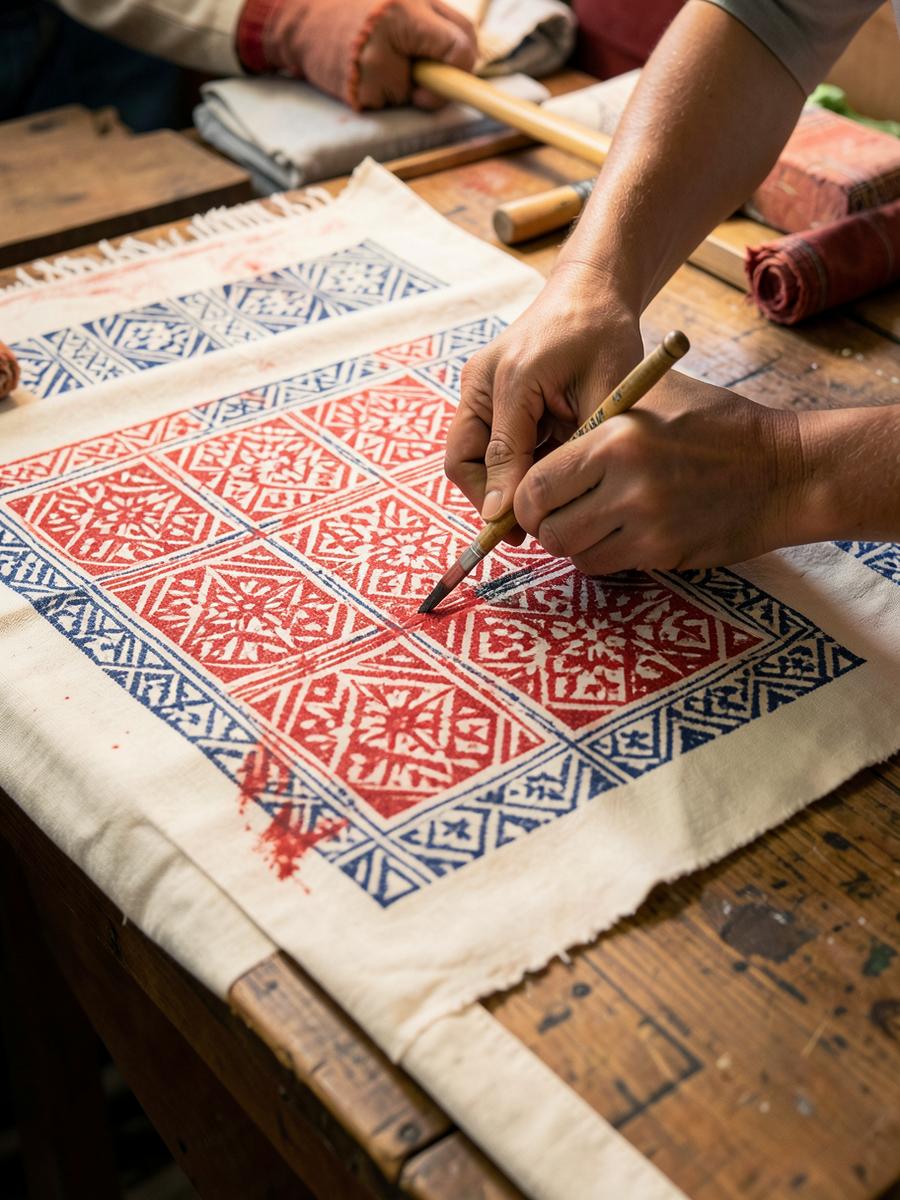
Ajrakh is not one technique but a long sequence of them. A single length of cloth passes through washing, mordanting, resist-printing, dyeing and drying again and again — often sixteen distinct stages before it is called finished.
Natural dyes, patient colour
The deep indigo comes from the indigo plant, the madder red from root, the black from iron and jaggery fermented for days. None of these colours arrive instantly; they deepen with each dip and each drying in the Kutch sun.
That is why an Ajrakh red never looks flat. Look closely and you will see the colour breathing across the weave.
Double-sided precision
Traditional Ajrakh is printed on both faces of the cloth, block aligned to block. A hand that slips by two millimetres shows on the finished saree, so this alignment is the true test of a printer's years at the table.
How to recognise the real thing
Hand-block Ajrakh has tiny irregularities — a motif slightly deeper here, a join visible there — and a soft, earthy smell from natural dye. Screen-printed imitations are uniformly perfect and smell of chemicals.